Pg 10
There’s plenty of evidence that traditionally femininity is no longer popular. Virtually everybody wants young women to be successful, so the traditional characteristics of femininity - passivity, reticence, assuming men and authority figures are right and that you are probably wrong-are therefore redundant.
Young women have a range of assertive “girl power” role models to choose from in magazine, movies and pop music
Pg64 gender in contemporary movie
[In the past and] today, every Hollywood women is someone else’s other. (1997:3)
Monday, February 26, 2007

Media, Gender and Identity an introduction David Gauntlett
Pg30- the effects model treats children as inadequate
The media effects studies positions children exclusively as potential “victims” of the mass media, and (rather cruelly) allow young people no opportunity to express their critical abilities, intelligence, or free will. Hundreds of shallow quantitative studies, usually conducted by “psychologists”, have often been little more than traps for the subjects, and ironically allow no scope for developing psychological insights. More generous research methods, which are willing to listen to children, have shown that they can talk intelligently and indeed cynically about the mass media (Buckingham,1993,1996), and that children as young as seven can make thoughtful, critical and “media literate” video productions themselves (Gauntlett,1997).
Media effects studies support conservative and right wing ideologies, even if that is not necessarily the conscious intention of the people producing them. The studies typically suggest that social problems are not rooted in the organisation of society, and inequalities, but are actually the evil magic products of popular culture. Their conception of screen violence as a meaningless but measurable “thing” also helps those who want to blame modern media instead of considering the serious social causes of the violence. The reasearchers’ categorisations of “antisocial” behaviour often reveal that they are worried about challenges to the status quo. The tendency to patronise and devalue children and young people, by assuming that they have no competencies worth considering, also fits with these illiberal trends.
The media effects studies positions children exclusively as potential “victims” of the mass media, and (rather cruelly) allow young people no opportunity to express their critical abilities, intelligence, or free will. Hundreds of shallow quantitative studies, usually conducted by “psychologists”, have often been little more than traps for the subjects, and ironically allow no scope for developing psychological insights. More generous research methods, which are willing to listen to children, have shown that they can talk intelligently and indeed cynically about the mass media (Buckingham,1993,1996), and that children as young as seven can make thoughtful, critical and “media literate” video productions themselves (Gauntlett,1997).
Media effects studies support conservative and right wing ideologies, even if that is not necessarily the conscious intention of the people producing them. The studies typically suggest that social problems are not rooted in the organisation of society, and inequalities, but are actually the evil magic products of popular culture. Their conception of screen violence as a meaningless but measurable “thing” also helps those who want to blame modern media instead of considering the serious social causes of the violence. The reasearchers’ categorisations of “antisocial” behaviour often reveal that they are worried about challenges to the status quo. The tendency to patronise and devalue children and young people, by assuming that they have no competencies worth considering, also fits with these illiberal trends.
Thursday, February 08, 2007
Representation of gender today-book research Pg75
Shrek (2001)
“A princess has to be rescued by the male ogre, Shrek.”
But finds Fiona is a “matrix-style martial expert herself”
“She worries about not looking beautiful, but so does Shrek”
“Both learn to be happy and equal”
“Women and men have similar skills and abilities”
Women having to be “attractive, within out recognised conventions of what makes a women attractive.”
“Leading men also have to be attractive within the recognised convention for males.”
“A princess has to be rescued by the male ogre, Shrek.”
But finds Fiona is a “matrix-style martial expert herself”
“She worries about not looking beautiful, but so does Shrek”
“Both learn to be happy and equal”
“Women and men have similar skills and abilities”
Women having to be “attractive, within out recognised conventions of what makes a women attractive.”
“Leading men also have to be attractive within the recognised convention for males.”
C4-100 greatest cartoons
Shrek/2
Anti fairytale-reverse of a fairytale
Shrek-enjoys swamp and isolation
Anti fairytale-reverse of a fairytale
Shrek-enjoys swamp and isolation
realism
Shrek 2 uses a convention called “cultural verisimilitude” which reflects American’s society and conveys how they are a capitalist society.
Wednesday, February 07, 2007
useful info from bbc review
The Kingdom of Far Far Away is the setting for a sledgehammer-subtle satire of Hollywood, which never offers anything dangerous or perceptive - just observation that it's glitzy, glamorous, and commercial.
Shrek 2 characters outed by U.S. group
TORONTO -- The hit feature Shrek 2 joins the ranks of animated films to be "outed" by some Christian fundamentalists in the U.S., who charge that cross-dressing and transgender themes should make parents think twice before picking up the DVD for the family. Although many people see the Oscar-nominated film as a humorous story about a green ogre and his true love, the Traditional Values Coalition has a different take on the feature.
Tue, February 22, 2005
http://www.canoe.ca/NewsStand/CalgarySun/News/2005/02/22/pf-938558.html
Tue, February 22, 2005
http://www.canoe.ca/NewsStand/CalgarySun/News/2005/02/22/pf-938558.html
useful info from the cnn review
"Shrek 2" feels just as fresh as the original.
Also look for a bit with a picture taped to the ceiling above Fiona's girlhood bed. The stud in the photo, "Sir Justin," looks a lot like a certain Justin dating a certain actress who happens to provide Fiona's voice in this film.
http://www.cnn.com/2004/SHOWBIZ/Movies/05/18/review.shrek2/index.html
Also look for a bit with a picture taped to the ceiling above Fiona's girlhood bed. The stud in the photo, "Sir Justin," looks a lot like a certain Justin dating a certain actress who happens to provide Fiona's voice in this film.
http://www.cnn.com/2004/SHOWBIZ/Movies/05/18/review.shrek2/index.html
useful info from a review
mostly fed on watered-down Golden Book renditions and, of course, bright, happy Disney translations. Beauty and goodness win, ugliness and evil don't, and the world is full of magical, mysterious creatures -- from elves and dwarves to fairy godmothers and Tinkerbells -- all ready and willing to serve us superior humans. And once we're old enough to realize what a line we've been fed, we give up and go to Disney World, hoping to recapture a bit of that naive magic,
It doesn't take long for kids to tire of the simplistic retellings of fairy tales we're bombarded with in our formative years -- few of us have actually read the dark and gruesome Brothers Grimm versions, after all, and so we're mostly fed on watered-down Golden Book renditions and, of course, bright, happy Disney translations. Beauty and goodness win, ugliness and evil don't, and the world is full of magical, mysterious creatures -- from elves and dwarves to fairy godmothers and Tinkerbells -- all ready and willing to serve us superior humans. And once we're old enough to realize what a line we've been fed, we give up and go to Disney World, hoping to recapture a bit of that naive magic, but instead we just get sick riding Space Mountain a dozen times in a row.
So here we have Shrek, born out of that precise mindset: the one that longs for the just world fairy tales reassure us exists while recognizing that that place is hopelessly idealistic.
its heart an entirely conventional fairy tale: beauty and goodness do win in the end, and ugliness and evil don't. Shrek, for all his green skin and trumpetlike ears, is really quite a cute and goodhearted ogre, and Farquaad is indeed an ugly little toad of a man, inside and out.
http://www.flickfilosopher.com/blog/2001/05/shrek_review.html
It doesn't take long for kids to tire of the simplistic retellings of fairy tales we're bombarded with in our formative years -- few of us have actually read the dark and gruesome Brothers Grimm versions, after all, and so we're mostly fed on watered-down Golden Book renditions and, of course, bright, happy Disney translations. Beauty and goodness win, ugliness and evil don't, and the world is full of magical, mysterious creatures -- from elves and dwarves to fairy godmothers and Tinkerbells -- all ready and willing to serve us superior humans. And once we're old enough to realize what a line we've been fed, we give up and go to Disney World, hoping to recapture a bit of that naive magic, but instead we just get sick riding Space Mountain a dozen times in a row.
So here we have Shrek, born out of that precise mindset: the one that longs for the just world fairy tales reassure us exists while recognizing that that place is hopelessly idealistic.
its heart an entirely conventional fairy tale: beauty and goodness do win in the end, and ugliness and evil don't. Shrek, for all his green skin and trumpetlike ears, is really quite a cute and goodhearted ogre, and Farquaad is indeed an ugly little toad of a man, inside and out.
http://www.flickfilosopher.com/blog/2001/05/shrek_review.html
Useful information:
Actress Cameron Diaz is considered one of the most beautiful women in Hollywood. And believe it or not, she thinks one of the most beautiful characters she's ever played is a green ogre, Princess Fiona in the animated movie "Shrek." Diaz gives voice to Fiona once again in "Shrek 2."
She's a princess with two faces, a beautiful one by day and a less than beautiful one at night,
Diaz disagrees. “I think Fiona's lovely as an ogre. I think she's beautiful, I think she's lovely. She's so soft and feminine and warm.”
http://www.cbsnews.com/stories/2004/05/17/earlyshow/leisure/celebspot/main617738.shtml
She's a princess with two faces, a beautiful one by day and a less than beautiful one at night,
Diaz disagrees. “I think Fiona's lovely as an ogre. I think she's beautiful, I think she's lovely. She's so soft and feminine and warm.”
http://www.cbsnews.com/stories/2004/05/17/earlyshow/leisure/celebspot/main617738.shtml
Useful info:princess fiona
It is only a recent phenomenon that children’s animated movie heroines kick butt
Princess Fiona is a typical, beautiful and beautifully dressed damsel in distress, but no weakling, she. In a “Matrix-like” fight sequence, Fiona makes easy work of Robin Hood and his Merry Men in a way that would make Stallone, Segal or Van Damme envious.
Princess Fiona is a typical, beautiful and beautifully dressed damsel in distress, but no weakling, she. In a “Matrix-like” fight sequence, Fiona makes easy work of Robin Hood and his Merry Men in a way that would make Stallone, Segal or Van Damme envious.
Does Blogging Help?
1.How easy has it been to set up your Independent Study blog and to get used to posting things on it? Were you given enough support in doing it? What other help would have been useful?
It was easy to set up the independent study blog because I remembered how to do it from last year so I personally didn’t really need support. I was use to posting things up on the blog because when we made blog for the practical production I posted up quite a lot of posts so it didn’t take much getting use too.
2. How did the blog help with your research? Did the blog motivate you to do more and better research? How? Why?
The blog helped with my research because it was all there in one place so when it came to writing the independent study it was easy to use/find the research. The blog personally motivated me to do more research because it well presented and the colours and pictures help me remember the information
3. Is it useful having all the Independent Study/blog tasks posted on the Macguffin blog? Does it make it more likely that you will get them done?
Yes it useful because if your absent you could just check the work on the blog.
4. How often (honestly!) do you check the Macguffin blog?
As much as I can.
5. Has it been useful being able to see and access everyone else’s research and planning through their blogs?
Well it can be useful but as no one is really doing animation it’s not that helpful for my independent study so it’s not very useful but then again it can be helpful when looking at the representation of women because a lot of people are doing representation of women.
6. How do you feel about the fact that your teacher can keep a close check on your progress through accessing your blog? Is it too intrusive and controlling or is it encouraging and supportive?
I don’t think it is controlling and intrusive because at the end of the day wheather you do your work on paper or the blog the teacher is still going to see it. It’s more encouraging and supportive as they can keep track of the research and preparation you are doing for your work
7. How useful have the comments been that you received from…a. Macguffin, b. other students.
I haven’t really received any comments.
8. How has the blog helped with your essay planning? How useful was the blog when it came to writing the essay? Do you think your first draft is better because you have used a blog?
The blog was useful for essay planning because we had to post up keywords on the blog and it was easier referring to the keywords from the blog then looking for each word in the essential word dictionary when writing. Yes I think it was better because of using the blog because I actually bothered to look at the keywords on the blog and remembered some because I had posted pictures and made the keywords colourful so that I remember because they stood out.
9. How would you evaluate the quality of your blog? What could you have done better?
I think my blog is excellent I really like the standard and the quality of it as I have put a lot of effort into it. I think the only thing I could have done to improve it is post up the actual book research or my key points from my book research.
10. Do you think you will get a better final grade for your independent study through having used a blog?
yes
11. Which are the best three blogs? Why?
It’s hard just to pick the best three because there are so many well presented blogs.
12. Do you think next year’s Year 13s would benefit from setting up an Independent Study blog?
well it certainly helped me so I guess it would.
13. Are there any negative aspects to preparing for an Independent Study using a blog?
Just that you may have issues logging into your blog.
14. What could be done to improve teaching and/or learning in future through blogs?
Just how to post videos up on the blog, I still don’t know. :S
15. Overall, are you pleased that we used blogs? Has it been interesting and enjoyable? Why? Why not?
Yes I am pleased we used blogs it has been enjoyable and motivating and its helped me develop my it skills.
It was easy to set up the independent study blog because I remembered how to do it from last year so I personally didn’t really need support. I was use to posting things up on the blog because when we made blog for the practical production I posted up quite a lot of posts so it didn’t take much getting use too.
2. How did the blog help with your research? Did the blog motivate you to do more and better research? How? Why?
The blog helped with my research because it was all there in one place so when it came to writing the independent study it was easy to use/find the research. The blog personally motivated me to do more research because it well presented and the colours and pictures help me remember the information
3. Is it useful having all the Independent Study/blog tasks posted on the Macguffin blog? Does it make it more likely that you will get them done?
Yes it useful because if your absent you could just check the work on the blog.
4. How often (honestly!) do you check the Macguffin blog?
As much as I can.
5. Has it been useful being able to see and access everyone else’s research and planning through their blogs?
Well it can be useful but as no one is really doing animation it’s not that helpful for my independent study so it’s not very useful but then again it can be helpful when looking at the representation of women because a lot of people are doing representation of women.
6. How do you feel about the fact that your teacher can keep a close check on your progress through accessing your blog? Is it too intrusive and controlling or is it encouraging and supportive?
I don’t think it is controlling and intrusive because at the end of the day wheather you do your work on paper or the blog the teacher is still going to see it. It’s more encouraging and supportive as they can keep track of the research and preparation you are doing for your work
7. How useful have the comments been that you received from…a. Macguffin, b. other students.
I haven’t really received any comments.
8. How has the blog helped with your essay planning? How useful was the blog when it came to writing the essay? Do you think your first draft is better because you have used a blog?
The blog was useful for essay planning because we had to post up keywords on the blog and it was easier referring to the keywords from the blog then looking for each word in the essential word dictionary when writing. Yes I think it was better because of using the blog because I actually bothered to look at the keywords on the blog and remembered some because I had posted pictures and made the keywords colourful so that I remember because they stood out.
9. How would you evaluate the quality of your blog? What could you have done better?
I think my blog is excellent I really like the standard and the quality of it as I have put a lot of effort into it. I think the only thing I could have done to improve it is post up the actual book research or my key points from my book research.
10. Do you think you will get a better final grade for your independent study through having used a blog?
yes
11. Which are the best three blogs? Why?
It’s hard just to pick the best three because there are so many well presented blogs.
12. Do you think next year’s Year 13s would benefit from setting up an Independent Study blog?
well it certainly helped me so I guess it would.
13. Are there any negative aspects to preparing for an Independent Study using a blog?
Just that you may have issues logging into your blog.
14. What could be done to improve teaching and/or learning in future through blogs?
Just how to post videos up on the blog, I still don’t know. :S
15. Overall, are you pleased that we used blogs? Has it been interesting and enjoyable? Why? Why not?
Yes I am pleased we used blogs it has been enjoyable and motivating and its helped me develop my it skills.
Sunday, February 04, 2007
my first draft of the essay/independant study
“I want what any princess wants – to live happily ever after… with the ogre I married.”[1] .How are heroes/heroines and villains typically represented in contemporary animation films? Paying close attention to “Shrek 2” (2004)
DreamWorks Animation SKG emerged in 2004, along with its most successful film sequel “Shrek 2”(Dir:Andrew Adamson).The “biggest CGI movie ever, grossing £470million”,[2]becoming Disney’s biggest competitor. Unlike most animated films, it challenged the normal codes and conventions expected from this genre by using Levi Strauss’ theory through reversing the binary opposition, making an ogre a “hero” and the fairy godmother a “villain” in Propp’s character roles.
The typical representation of the heroine/hero is being “good looking”[3] and having “youthful traits.”[4] This includes characterstics such as “big eyes and round cheeks.”[5] Which are are illustrated in “smooth,round,soft,bright,curves and with european features.”[6] Whereas, the villian is “drawn with sharp angles,oversized, often darkly” [7] and “often ugly”[8] looking. This is because the “colour,shape and size evoke certain psycholoigcal responses and attidues towards an object.”[9]
“Shrek 2” can be seen as a parody or a pastiche that uses the traditonal characters from Disney films and fairy tales to subvert sterotypical roles. For example, “the big bad wolf” is shown in a postive relationship with the three little pigs, Pinocheo and Shrek as they are all friends. This again reverses the binary oppostion as he is portrayed as a hero as he is on Shrek’s side. Moreover, he is represented as a disoriented being. This is conveyed in the course of the film as the fairy godmother refers to him as the “gender confused wolf.”[10] Another trait that shows this is that fact that he is dressed in Little Red Riding Hoods’ grandmother’s clothes which suggests that he is a cross dresser. This has been constructed in this way to create humour for the audience which is done by “mixing modern and fantasy culture.”[11]
Even thought the producers of “Shrek 2” represent cross dressers and the transgender bartender the audience may perceive them as being negatively represented and supporting the “status quo” because they are shown with all the other villains in “the poison apple” which suggests cross dressers and transgender people are bad characters. This supports the homophobic view as they show the villains segregated from the other people in “far far away” which portrays “the shallowness of Hollywood.” [12]
However, Pinocchio is implicitly referred to as a cross dresser, in a scene where he is going to save Shrek he is asked if he wears women underwear and because he lies he noses starts to grow. This angered many conserative groups “who objected to the film's sexual content. However, these concerns were widely ridiculed in the media.”[13] Although he is represented in this way he was still a likeable character this is mainly because he is a friend of Shrek and supported him.
In contrast, to many animated films, “Shrek 2” is aimed at two audiences. The primary audience are children who gain pleasure through escapism, scopophilia and identification with the main protagonists this is because the animation “visually stimulates their emotions.” [14] Furthermore, “psychologist suggests that children under 6 can not tell the difference between fantasy and reality” [15] and “children under 5 love repetition.”[16] Whereas, the secondary audience who are adults/teenagers gain pleasure due to the nostalgia feeling, appeal of the stars/celebrities and the narrative itself. Overall, “Shrek 2” is aimed at a mainstream audience and appeals to all ethnicities and ages.
The “uses and gratification” theory suggests the audience watch the film for entertainment and escapism and the fact that the sub genre is fantasy, adventure and comedy contributes to the pleasure received by the audience. On the other hand, the effects theory implies, as it is an American text, American ideologies and values are likely to be picked up. Additionally, the reception theory proposes the children are likely to pick up the hegemonic reading, whereas an adult or a teenage may grasp a negotiated reading or an oppositional reading.
The producers of “Shrek 2” rely on an active audience, who understand the jokes and the imitations of the characters from Disney films this supports the hilarity created and strengthens the ideology of the text. The mockery of the Disney films mirrors “Disney's hostile relations with DreamWorks co-founder Katzenberg”. [17] Who got fired for asking for a promotion after one of his colleagues had passed away. A lawsuit was filed against Disney to claim the money that was owed to Katzenberg.
The representation of heroines has changed drastically by looking at previous animated films such as “Snow White and the Seven Dwarfs” (1937), “Cinderella” (1950) and “Walt Disney's Sleeping Beauty” (1959). Cinderella, Snow White and Aurora were represented in two typically roles. The first role was the “princess” in Prop’s narrative roles. This resulted them in playing pretty, passive, homemakers who were subordinate to men. The second role they all performed was “the damsel in distress” this helps reinforce patriarchy as the women were dependant upon the males to come and rescue them.
The representation of villains in “Cinderella, “Snow White and the Seven Dwarfs” and “Sleeping Beauty” films were all women, the way in which they are typically represented is by the way they are drawn. Maleficent has “the fang shape in the horns on her head”[18] to connote her devilish personality. The wiked queen in “Snow White” had the fang shape in the collar of the cloak, and the narrowed, tricky eyes to connote her evilness.
Whereas, with “Lady Tremaine” had a cat named Lucifer to connote her personality, who was similarly represented as the fairy godmother from “Shrek 2” as she was a “woman determined to forward her own interests as well as that of her daughters.” [19] this encourages the audiece to hate these villians and make it easier for them to conflict agaist them. However, young girls may enjoy the “strenght and the power” [20] these women hold and aspire to be like them. However, according to Freud they would also want to be like the heroine as “every child at some time wishes that s/he were a prince or a princess--and at times, in his/her unconscious, the child believes s/he is one, only temporarily degraded by circumstances.” [21]
Another typical role for the heroine is being a princess. The typical representation of a princess is to be “elegant”, “gentle” and feminine. The American conation of the word “princess” is “any woman of exceptional popularity.” [22] The typical costume a princess would wear is a formal dress “usually, a ball gown” [23] with high heels that are match her outfit. However “the contemporary style shows her wearing flats. On the head, a crown, diadem, or tiara is often worn.” [24]
Conversely, in “Shrek 2” Fiona plays an active heroine as she “expertly fights in hand-to-hand combat with martial arts skills” [25] this is shown when the ninjas begin to attack her and Shrek, (when Shrek is caught in the trap and hanging off the tree.) This is constructed “to display a much more feminized version of the traditional fairy tale princess” [26] and to indicate how the society is now more post feminist. Whereas, in the pre-equal “Shrek” (2001) she acts slightly more passive as she takes on the role of the “damsel of distress”. This is represented to the audience by her having “high expectations of how she is to be rescued, and who is to rescue her.”[27]
Fiona challenges how a typical woman should look, when she is in her ogre form, as she is represented as “fat” and “ugly” this is conveyed in “Shrek” (2001) when she hides away at night so that Shrek and Donkey does not see her looking “ugly”. Furthermore, when she is transformed into a human woman, she is represented as slim, fair and beautiful this suggest Mulvey’s theory on the “male gaze” is valid as it helps supports the hegemony of women having to be slim to remain attractive. Moreover, the stereotype of fat people being “jolly/happy” is reinforced because Fiona chooses to look like an ogre. But, she subverts the typical heroine role as she is happy looking “ugly” which again reverses the binary opposition and creates a new ideology for the young audience which is “real beauty comes from the inside.” [28]
This message is similar to Disney’s “beauty and the beast” (1991) as Shrek is represented parallel to the beast, he is conveyed as an “ogre” to begin with and then during the middle of the narrative transforms into a good-looking man at this stage in the film he has three maids arguing over him and the “female gaze” is conveyed when he has to change his clothes and the girls/maids are excited about that. In the end/resolution he is an “ogre” again. However with “beauty and the beast” the protagonist starts off as a prince and is then turned into a beast and during the resolution is transformed back into the prince when he learns not to be so selfish and the spell is broken.
Shrek acts “Like an ogre!” [29] by challanging royalty therefore going against the norms of society and showing deviant behaviour. The way Shrek behaves can be seen normal to the audience because the whole kingdom haves predjuices attitudes against him, which in a way can justify his actions and opinions towards them.The text is produced in this way to show a reflection of british society today. The british royal family are seen as the “knocking copy” as they are made fun of and exposed to the whole country in successful british tabloid newspapers such as “The Sun”. Moreover, it portrays how americans feel about kings and queens as they do not have any in the united states, this can reflect how they see royalty to be indaequate which encourages them to understand Shrek.
Shrek is adapted from the “Yiddish word meaning 'fear', 'terror', or (in its closest sense) 'fright'.” [30] The film conforms and play up to the connations and dennotations of the word “Shrek”. When donkey says “Oh, don't feel bad, Shrek. Almost everybody who meets you wants to kill you.” [31] Makes the audience feel sympathy for Shrek. So, instead of being scared and alienated towards Shrek, the audience identify with him and can feel empathy. This helps challenge the stereotype of “ogres” because Shrek is represented as “a large, strong, peace-loving green ogre.”[32] Yet again, Strauss’ theory on binary oppostion is reversed, to challenge the audience.
On the other hand, a key scene that shows Shrek in a typical role of a hero is when he tries to break into the castle to rescue Fiona from Prince Charming. The cinematography used in the scene is a big close up of Shrek which is then turned into a long shot while the parallel off-screen sound of “I need a hero” is sang by the fairy godmother which is parallel to the action seen by the audience, which is Shrek riding on a white horse which reinforces the traditional stereotypes of a typical hero. This is done to help the younger audience identify with Shrek, as he is the one playing the role of a hero. It can also be seen as ironic as fairy godmother is singing the song.
The villians in “Shrek 2” are represented in a more comical rather then scary. The villians are seen as “the other” in nandy’s theory therefore they are given comedy charasterstics to make them less threating. The role reversal could be because children are no longer scared of monster,witches and ghosts. Instead, are scared of terrorist after the nineth of September attacks in 2000. In most recent animated films the villians have typically been a supernatural being or an animal.
Donkey is another comical character used in “shrek 2” he is likeable character to many of the audience and is the “helper” in Propp’s character roles. The actor that plays him is Eddie Murphy who become a “star in the 1980s”[33] he is placed in many comedy roles which makes him conform to the role of “black entertainer”and ”racial clown” this could be because he is then “safe for white audiences.”[34]
Fairy godmother who acquires the role of the villain is characterized in the complete opposite of a typical fairy godmother, seeing that she is “scheming, conniving, opportunist of a woman, who sought to get the best for herself and her son, rather than others.” [35] She clearly does not care about Fiona emotionally, as she tries to sabotage Shrek and Fiona’s marriage every chance possible. Fairy godmother is represented negatively. She is the most powerful women in the film because of the wand she clings on to. The wand has conations of a phallic object which represent the power she holds as she is un-castrated. Although, she has power she is still an un-likable character for the audience who are positioned to feel alienated towards which in a way helps reinforce misogyny.
The normal codes and conventions “Shrek 2” follows are the representation of supernatural beings. Unlike Disney, the producers of “Shrek 2” show the antagonist fairy godmother with magical powers this is created to support the dominant ideology of women being inferior to a man. By giving fairy godmother magical powers it represents her as weak as she needs the support of a man. The wand is the object that gives her the power which connotes a phallic object that can be seen to represent a part of a man with her to try and defeat the hero.
Another typical character that is subverted is the role of Prince Charming in “Shrek 2” he is represented as a “weak-willed mummy's boy.”[36] In historic films such as “Cinderella,” “Sleeping Beauty” and “Snow White And The Seven Dwarfs”, he is represented in the role of a “hero” as he saves all three of the heroines and they live “happily ever after” but the cause for the change in representation can be down to a several reasons.
Firstly, due to society changing and becoming post modern most of the conservative ideologies are rejected. Secondly, it could be perceived as another sarcastic remark about Disney films. Seeing that, Prince Charming is another version of “Gaston” from “Beauty and the Beast.”(1991) this suggests that the changing representations are not altered to encourage social change instead they are made to mock and have another dig at Disney. Thirdly, the familiarity of the characters and altering them slightly, encourages children to watch the film and receive pleasure.
Disney’s Beauty and the Beast had the “highest number of sales which made it the third-most successful movie of 1991.” [37] Unlike, “Shrek and Shrek 2” it tried to help reinforce patriachy as Gaston made “chauvinistic comments”[38] like refering to Bella as the "little wife" [39] and having six or seven "strapping boys".[40]
In contrast to Gaston, Bella is represented as a polite women, which makes her the heroine in propp’s narrative roles. Princess Fiona, on the other hand, is represented as more assertive, ugly and unmannerly when she is an ogre as she takes on ogre characterstics like burping loud and not being ashamed of it. However in her human form she seem to be more “down to earth”. [41]
Similary, “Mulan is a very different type of heroine.”[42] She goes against sterotypes as she is a ethnic minority who is the main protagnist. She goes against sterotypical roles as she is an active heroine who drives the narrative forward. The producers of this text represent her as rebellious and strong because “she always speaks her mind and goes against the wishes of her family by pretending to be a soldier and going to war.”[43] The audience are encouraged to identify with her because they see things from her presepective.The ideolgies in “Mulan” is to encourage social change as the period in the film is set in a patriachal time. However, to promote the change she has to be sneaky,sly and be untruthful to promote “girl power”.
“Hoodwinked”(2006) is a dectective style, family-comedy. It is a recent low budget computer generated imagery movie, which is similar to Shrek as it uses the same conventions. For example, making references to other films for instance “XXX” and subverting the character roles. By making Boinge, (the most cutest bunny) the villian. Boinge is the “goody bandit” which is a binary opposite itself. The conations and denotations correlates the villain who appears to be “goody” however he is represented as a “bandit” therefore making him a “baddie.”
Again, the role of the “big bad wolf” is switched as in this film he is a reporter trying to catch the “goody bandit” and is represented as sarcastic. Anthropomorphism is a convention used in many animated films. In “Hoodwinked” (2006) the frog interviews the three humans and the wolf. This convention is used to help “engage audiences with the experiences of animal characters”.[44] “Hoodwinked” relies on an active audience as follows a non linear narrative.
Shrek 2 can be seen as a classic realism text as it follows Todrov’s theory on narrative structure. The equilbruim is there to begin with when Shrek and Fiona are on their honeymoon. The dis-equilbruim then crops up when they receive an invitation from Fiona parents and the disequilbruim is resolved when the Shrek is accepted by the kingdom of “far far away” which promotes progressive values. Typically “the hero represents the truimph of what society holds to be good”[45] However, in this case the society learns to accept Shrek. But as the audience see Shrek as a hero, the good truimphs evil ideology conforms to the “moral outcome that is typical of most hollywood films.” [46]
To finish, “Shrek 2” follows the tried and tested formula by using “myths and legends which usually have the same ingredients: a hero or heroine, a baddie, a fight or a conflict and in the end, good almost always wins over evil.”[47] Though, the way in which heroes/heroines and villains are represented have changed to some extent this is partly due to society changing. Therefore the stereotypical roles are challenged as society is now pluralistic, post-modern and post-feminist. Finally, the representations of heroes/heroines and villains can never be accurate as the majority of the audience believe animation is “fictive, not real: it’s just a cartoon!” [48]
Words: 2995
[1]Shrek 2 (2004)
[2]http://www.thesun.co.uk/article/0,,2-2007000220_7,00.html
[3]Lacey, Nick (2002) : Narrative and genre, New York, Palgrave pg66-67
[4]http://lass.calumet.purdue.edu/cca/gmj/OldSiteBackup/SubmittedDocuments/archivedpapers/fall2002/Artz.htm
[5]http://lass.calumet.purdue.edu/cca/gmj/OldSiteBackup/SubmittedDocuments/archivedpapers/fall2002/Artz.htm
[6]http://lass.calumet.purdue.edu/cca/gmj/OldSiteBackup/SubmittedDocuments/archivedpapers/fall2002/Artz.htm
[7]http://lass.calumet.purdue.edu/cca/gmj/OldSiteBackup/SubmittedDocuments/archivedpapers/fall2002/Artz.htm
[8]Lacey, Nick (2002) : Narrative and genre, New York, Palgrave pg66-67
[9]http://lass.calumet.purdue.edu/cca/gmj/OldSiteBackup/SubmittedDocuments/archivedpapers/fall2002/Artz.htm
[10]http://en.wikipedia.org/wiki/Big_Bad_Wolf_%28Shrek%29
[11]http://en.wikipedia.org/wiki/Hoodwinked
[12]http://www.answers.com/topic/princess-fiona
[13]http://en.wikipedia.org/wiki/Big_Bad_Wolf#Shrek.27s_Big_Bad_Wolf
[14]http://goliath.ecnext.com/coms2/summary_0199-36853_ITM
[15]Simpson, Paul (2004): the rough guide to kids' movies. New York, rough guides.
[16]Simpson, Paul (2004): the rough guide to kids' movies. New York, rough guides
[17]http://en.wikipedia.org/wiki/Dreamworks
[18]http://www.wavecrest.org.uk/wavecrest/Quest%20tease%2010.htm
[19]http://en.wikipedia.org/wiki/Lady_Tremaine
[20]http://www.gwu.edu/~folktale/GERM232/sleepingb/Disney.html
[21]http://www.surlalunefairytales.com/goosegirl/notes.html
[22]http://en.wikipedia.org/wiki/Princess
[23]http://en.wikipedia.org/wiki/Princess
[24]http://en.wikipedia.org/wiki/Princess
[25]http://en.wikipedia.org/wiki/Princess_Fiona
[26]http://en.wikipedia.org/wiki/Princess_Fiona
[27]http://en.wikipedia.org/wiki/Princess_Fiona
[28]http://www.mutantreviewers.com/rshrek2.html
[29]Shrek 2 (2004)
[30]http://en.wikipedia.org/wiki/Shrek
[31]Shrek 2 (2004)
[32]http://en.wikipedia.org/wiki/Shrek
[33]Tim o Sullivan, Brian Dutton and Philip Rayner (2003) : Studying the media (3rd edition) London, Arnold
[34]Tim o Sullivan, Brian Dutton and Philip Rayner (2003) : Studying the media (3rd edition) London, Arnold
[35]http://en.wikipedia.org/wiki/Fairy_Godmother_%28Shrek%29el
[36]http://www.dailyinfo.co.uk/reviews/feature/446/Shrek+2/
[37]http://en.wikipedia.org/wiki/Disney%27s_Beauty_and_the_Beast
[38]http://en.wikipedia.org/wiki/Disney%27s_Beauty_and_the_Beast
[39]beauty and the beast (1991)
[40]]beauty and the beast (1991)
[41]http://en.wikipedia.org/wiki/Princess_Fiona
[42]http://www.filmeducation.org/primary/Mulan/mulan3.html
[43]http://www.filmeducation.org/primary/Mulan/mulan3.html
[44]Philip Alan (2005): Essential word dictionary, Oxfordshire, Raithby, Lawrence and Co Ltd, Leicester
[45]Lacey, Nick (2002): Narrative and genre, New York, Palgrave
[46]Tim o Sullivan, Brian Dutton and Philip Rayner (2003) : Studying the media (3rd edition) London, Arnold
[47]http://www.filmeducation.org/primary/Mulan/index.html
[48]http://lass.calumet.purdue.edu/cca/gmj/OldSiteBackup/SubmittedDocuments/archivedpapers/fall2002/Artz.htm
DreamWorks Animation SKG emerged in 2004, along with its most successful film sequel “Shrek 2”(Dir:Andrew Adamson).The “biggest CGI movie ever, grossing £470million”,[2]becoming Disney’s biggest competitor. Unlike most animated films, it challenged the normal codes and conventions expected from this genre by using Levi Strauss’ theory through reversing the binary opposition, making an ogre a “hero” and the fairy godmother a “villain” in Propp’s character roles.
The typical representation of the heroine/hero is being “good looking”[3] and having “youthful traits.”[4] This includes characterstics such as “big eyes and round cheeks.”[5] Which are are illustrated in “smooth,round,soft,bright,curves and with european features.”[6] Whereas, the villian is “drawn with sharp angles,oversized, often darkly” [7] and “often ugly”[8] looking. This is because the “colour,shape and size evoke certain psycholoigcal responses and attidues towards an object.”[9]
“Shrek 2” can be seen as a parody or a pastiche that uses the traditonal characters from Disney films and fairy tales to subvert sterotypical roles. For example, “the big bad wolf” is shown in a postive relationship with the three little pigs, Pinocheo and Shrek as they are all friends. This again reverses the binary oppostion as he is portrayed as a hero as he is on Shrek’s side. Moreover, he is represented as a disoriented being. This is conveyed in the course of the film as the fairy godmother refers to him as the “gender confused wolf.”[10] Another trait that shows this is that fact that he is dressed in Little Red Riding Hoods’ grandmother’s clothes which suggests that he is a cross dresser. This has been constructed in this way to create humour for the audience which is done by “mixing modern and fantasy culture.”[11]
Even thought the producers of “Shrek 2” represent cross dressers and the transgender bartender the audience may perceive them as being negatively represented and supporting the “status quo” because they are shown with all the other villains in “the poison apple” which suggests cross dressers and transgender people are bad characters. This supports the homophobic view as they show the villains segregated from the other people in “far far away” which portrays “the shallowness of Hollywood.” [12]
However, Pinocchio is implicitly referred to as a cross dresser, in a scene where he is going to save Shrek he is asked if he wears women underwear and because he lies he noses starts to grow. This angered many conserative groups “who objected to the film's sexual content. However, these concerns were widely ridiculed in the media.”[13] Although he is represented in this way he was still a likeable character this is mainly because he is a friend of Shrek and supported him.
In contrast, to many animated films, “Shrek 2” is aimed at two audiences. The primary audience are children who gain pleasure through escapism, scopophilia and identification with the main protagonists this is because the animation “visually stimulates their emotions.” [14] Furthermore, “psychologist suggests that children under 6 can not tell the difference between fantasy and reality” [15] and “children under 5 love repetition.”[16] Whereas, the secondary audience who are adults/teenagers gain pleasure due to the nostalgia feeling, appeal of the stars/celebrities and the narrative itself. Overall, “Shrek 2” is aimed at a mainstream audience and appeals to all ethnicities and ages.
The “uses and gratification” theory suggests the audience watch the film for entertainment and escapism and the fact that the sub genre is fantasy, adventure and comedy contributes to the pleasure received by the audience. On the other hand, the effects theory implies, as it is an American text, American ideologies and values are likely to be picked up. Additionally, the reception theory proposes the children are likely to pick up the hegemonic reading, whereas an adult or a teenage may grasp a negotiated reading or an oppositional reading.
The producers of “Shrek 2” rely on an active audience, who understand the jokes and the imitations of the characters from Disney films this supports the hilarity created and strengthens the ideology of the text. The mockery of the Disney films mirrors “Disney's hostile relations with DreamWorks co-founder Katzenberg”. [17] Who got fired for asking for a promotion after one of his colleagues had passed away. A lawsuit was filed against Disney to claim the money that was owed to Katzenberg.
The representation of heroines has changed drastically by looking at previous animated films such as “Snow White and the Seven Dwarfs” (1937), “Cinderella” (1950) and “Walt Disney's Sleeping Beauty” (1959). Cinderella, Snow White and Aurora were represented in two typically roles. The first role was the “princess” in Prop’s narrative roles. This resulted them in playing pretty, passive, homemakers who were subordinate to men. The second role they all performed was “the damsel in distress” this helps reinforce patriarchy as the women were dependant upon the males to come and rescue them.
The representation of villains in “Cinderella, “Snow White and the Seven Dwarfs” and “Sleeping Beauty” films were all women, the way in which they are typically represented is by the way they are drawn. Maleficent has “the fang shape in the horns on her head”[18] to connote her devilish personality. The wiked queen in “Snow White” had the fang shape in the collar of the cloak, and the narrowed, tricky eyes to connote her evilness.
Whereas, with “Lady Tremaine” had a cat named Lucifer to connote her personality, who was similarly represented as the fairy godmother from “Shrek 2” as she was a “woman determined to forward her own interests as well as that of her daughters.” [19] this encourages the audiece to hate these villians and make it easier for them to conflict agaist them. However, young girls may enjoy the “strenght and the power” [20] these women hold and aspire to be like them. However, according to Freud they would also want to be like the heroine as “every child at some time wishes that s/he were a prince or a princess--and at times, in his/her unconscious, the child believes s/he is one, only temporarily degraded by circumstances.” [21]
Another typical role for the heroine is being a princess. The typical representation of a princess is to be “elegant”, “gentle” and feminine. The American conation of the word “princess” is “any woman of exceptional popularity.” [22] The typical costume a princess would wear is a formal dress “usually, a ball gown” [23] with high heels that are match her outfit. However “the contemporary style shows her wearing flats. On the head, a crown, diadem, or tiara is often worn.” [24]
Conversely, in “Shrek 2” Fiona plays an active heroine as she “expertly fights in hand-to-hand combat with martial arts skills” [25] this is shown when the ninjas begin to attack her and Shrek, (when Shrek is caught in the trap and hanging off the tree.) This is constructed “to display a much more feminized version of the traditional fairy tale princess” [26] and to indicate how the society is now more post feminist. Whereas, in the pre-equal “Shrek” (2001) she acts slightly more passive as she takes on the role of the “damsel of distress”. This is represented to the audience by her having “high expectations of how she is to be rescued, and who is to rescue her.”[27]
Fiona challenges how a typical woman should look, when she is in her ogre form, as she is represented as “fat” and “ugly” this is conveyed in “Shrek” (2001) when she hides away at night so that Shrek and Donkey does not see her looking “ugly”. Furthermore, when she is transformed into a human woman, she is represented as slim, fair and beautiful this suggest Mulvey’s theory on the “male gaze” is valid as it helps supports the hegemony of women having to be slim to remain attractive. Moreover, the stereotype of fat people being “jolly/happy” is reinforced because Fiona chooses to look like an ogre. But, she subverts the typical heroine role as she is happy looking “ugly” which again reverses the binary opposition and creates a new ideology for the young audience which is “real beauty comes from the inside.” [28]
This message is similar to Disney’s “beauty and the beast” (1991) as Shrek is represented parallel to the beast, he is conveyed as an “ogre” to begin with and then during the middle of the narrative transforms into a good-looking man at this stage in the film he has three maids arguing over him and the “female gaze” is conveyed when he has to change his clothes and the girls/maids are excited about that. In the end/resolution he is an “ogre” again. However with “beauty and the beast” the protagonist starts off as a prince and is then turned into a beast and during the resolution is transformed back into the prince when he learns not to be so selfish and the spell is broken.
Shrek acts “Like an ogre!” [29] by challanging royalty therefore going against the norms of society and showing deviant behaviour. The way Shrek behaves can be seen normal to the audience because the whole kingdom haves predjuices attitudes against him, which in a way can justify his actions and opinions towards them.The text is produced in this way to show a reflection of british society today. The british royal family are seen as the “knocking copy” as they are made fun of and exposed to the whole country in successful british tabloid newspapers such as “The Sun”. Moreover, it portrays how americans feel about kings and queens as they do not have any in the united states, this can reflect how they see royalty to be indaequate which encourages them to understand Shrek.
Shrek is adapted from the “Yiddish word meaning 'fear', 'terror', or (in its closest sense) 'fright'.” [30] The film conforms and play up to the connations and dennotations of the word “Shrek”. When donkey says “Oh, don't feel bad, Shrek. Almost everybody who meets you wants to kill you.” [31] Makes the audience feel sympathy for Shrek. So, instead of being scared and alienated towards Shrek, the audience identify with him and can feel empathy. This helps challenge the stereotype of “ogres” because Shrek is represented as “a large, strong, peace-loving green ogre.”[32] Yet again, Strauss’ theory on binary oppostion is reversed, to challenge the audience.
On the other hand, a key scene that shows Shrek in a typical role of a hero is when he tries to break into the castle to rescue Fiona from Prince Charming. The cinematography used in the scene is a big close up of Shrek which is then turned into a long shot while the parallel off-screen sound of “I need a hero” is sang by the fairy godmother which is parallel to the action seen by the audience, which is Shrek riding on a white horse which reinforces the traditional stereotypes of a typical hero. This is done to help the younger audience identify with Shrek, as he is the one playing the role of a hero. It can also be seen as ironic as fairy godmother is singing the song.
The villians in “Shrek 2” are represented in a more comical rather then scary. The villians are seen as “the other” in nandy’s theory therefore they are given comedy charasterstics to make them less threating. The role reversal could be because children are no longer scared of monster,witches and ghosts. Instead, are scared of terrorist after the nineth of September attacks in 2000. In most recent animated films the villians have typically been a supernatural being or an animal.
Donkey is another comical character used in “shrek 2” he is likeable character to many of the audience and is the “helper” in Propp’s character roles. The actor that plays him is Eddie Murphy who become a “star in the 1980s”[33] he is placed in many comedy roles which makes him conform to the role of “black entertainer”and ”racial clown” this could be because he is then “safe for white audiences.”[34]
Fairy godmother who acquires the role of the villain is characterized in the complete opposite of a typical fairy godmother, seeing that she is “scheming, conniving, opportunist of a woman, who sought to get the best for herself and her son, rather than others.” [35] She clearly does not care about Fiona emotionally, as she tries to sabotage Shrek and Fiona’s marriage every chance possible. Fairy godmother is represented negatively. She is the most powerful women in the film because of the wand she clings on to. The wand has conations of a phallic object which represent the power she holds as she is un-castrated. Although, she has power she is still an un-likable character for the audience who are positioned to feel alienated towards which in a way helps reinforce misogyny.
The normal codes and conventions “Shrek 2” follows are the representation of supernatural beings. Unlike Disney, the producers of “Shrek 2” show the antagonist fairy godmother with magical powers this is created to support the dominant ideology of women being inferior to a man. By giving fairy godmother magical powers it represents her as weak as she needs the support of a man. The wand is the object that gives her the power which connotes a phallic object that can be seen to represent a part of a man with her to try and defeat the hero.
Another typical character that is subverted is the role of Prince Charming in “Shrek 2” he is represented as a “weak-willed mummy's boy.”[36] In historic films such as “Cinderella,” “Sleeping Beauty” and “Snow White And The Seven Dwarfs”, he is represented in the role of a “hero” as he saves all three of the heroines and they live “happily ever after” but the cause for the change in representation can be down to a several reasons.
Firstly, due to society changing and becoming post modern most of the conservative ideologies are rejected. Secondly, it could be perceived as another sarcastic remark about Disney films. Seeing that, Prince Charming is another version of “Gaston” from “Beauty and the Beast.”(1991) this suggests that the changing representations are not altered to encourage social change instead they are made to mock and have another dig at Disney. Thirdly, the familiarity of the characters and altering them slightly, encourages children to watch the film and receive pleasure.
Disney’s Beauty and the Beast had the “highest number of sales which made it the third-most successful movie of 1991.” [37] Unlike, “Shrek and Shrek 2” it tried to help reinforce patriachy as Gaston made “chauvinistic comments”[38] like refering to Bella as the "little wife" [39] and having six or seven "strapping boys".[40]
In contrast to Gaston, Bella is represented as a polite women, which makes her the heroine in propp’s narrative roles. Princess Fiona, on the other hand, is represented as more assertive, ugly and unmannerly when she is an ogre as she takes on ogre characterstics like burping loud and not being ashamed of it. However in her human form she seem to be more “down to earth”. [41]
Similary, “Mulan is a very different type of heroine.”[42] She goes against sterotypes as she is a ethnic minority who is the main protagnist. She goes against sterotypical roles as she is an active heroine who drives the narrative forward. The producers of this text represent her as rebellious and strong because “she always speaks her mind and goes against the wishes of her family by pretending to be a soldier and going to war.”[43] The audience are encouraged to identify with her because they see things from her presepective.The ideolgies in “Mulan” is to encourage social change as the period in the film is set in a patriachal time. However, to promote the change she has to be sneaky,sly and be untruthful to promote “girl power”.
“Hoodwinked”(2006) is a dectective style, family-comedy. It is a recent low budget computer generated imagery movie, which is similar to Shrek as it uses the same conventions. For example, making references to other films for instance “XXX” and subverting the character roles. By making Boinge, (the most cutest bunny) the villian. Boinge is the “goody bandit” which is a binary opposite itself. The conations and denotations correlates the villain who appears to be “goody” however he is represented as a “bandit” therefore making him a “baddie.”
Again, the role of the “big bad wolf” is switched as in this film he is a reporter trying to catch the “goody bandit” and is represented as sarcastic. Anthropomorphism is a convention used in many animated films. In “Hoodwinked” (2006) the frog interviews the three humans and the wolf. This convention is used to help “engage audiences with the experiences of animal characters”.[44] “Hoodwinked” relies on an active audience as follows a non linear narrative.
Shrek 2 can be seen as a classic realism text as it follows Todrov’s theory on narrative structure. The equilbruim is there to begin with when Shrek and Fiona are on their honeymoon. The dis-equilbruim then crops up when they receive an invitation from Fiona parents and the disequilbruim is resolved when the Shrek is accepted by the kingdom of “far far away” which promotes progressive values. Typically “the hero represents the truimph of what society holds to be good”[45] However, in this case the society learns to accept Shrek. But as the audience see Shrek as a hero, the good truimphs evil ideology conforms to the “moral outcome that is typical of most hollywood films.” [46]
To finish, “Shrek 2” follows the tried and tested formula by using “myths and legends which usually have the same ingredients: a hero or heroine, a baddie, a fight or a conflict and in the end, good almost always wins over evil.”[47] Though, the way in which heroes/heroines and villains are represented have changed to some extent this is partly due to society changing. Therefore the stereotypical roles are challenged as society is now pluralistic, post-modern and post-feminist. Finally, the representations of heroes/heroines and villains can never be accurate as the majority of the audience believe animation is “fictive, not real: it’s just a cartoon!” [48]
Words: 2995
[1]Shrek 2 (2004)
[2]http://www.thesun.co.uk/article/0,,2-2007000220_7,00.html
[3]Lacey, Nick (2002) : Narrative and genre, New York, Palgrave pg66-67
[4]http://lass.calumet.purdue.edu/cca/gmj/OldSiteBackup/SubmittedDocuments/archivedpapers/fall2002/Artz.htm
[5]http://lass.calumet.purdue.edu/cca/gmj/OldSiteBackup/SubmittedDocuments/archivedpapers/fall2002/Artz.htm
[6]http://lass.calumet.purdue.edu/cca/gmj/OldSiteBackup/SubmittedDocuments/archivedpapers/fall2002/Artz.htm
[7]http://lass.calumet.purdue.edu/cca/gmj/OldSiteBackup/SubmittedDocuments/archivedpapers/fall2002/Artz.htm
[8]Lacey, Nick (2002) : Narrative and genre, New York, Palgrave pg66-67
[9]http://lass.calumet.purdue.edu/cca/gmj/OldSiteBackup/SubmittedDocuments/archivedpapers/fall2002/Artz.htm
[10]http://en.wikipedia.org/wiki/Big_Bad_Wolf_%28Shrek%29
[11]http://en.wikipedia.org/wiki/Hoodwinked
[12]http://www.answers.com/topic/princess-fiona
[13]http://en.wikipedia.org/wiki/Big_Bad_Wolf#Shrek.27s_Big_Bad_Wolf
[14]http://goliath.ecnext.com/coms2/summary_0199-36853_ITM
[15]Simpson, Paul (2004): the rough guide to kids' movies. New York, rough guides.
[16]Simpson, Paul (2004): the rough guide to kids' movies. New York, rough guides
[17]http://en.wikipedia.org/wiki/Dreamworks
[18]http://www.wavecrest.org.uk/wavecrest/Quest%20tease%2010.htm
[19]http://en.wikipedia.org/wiki/Lady_Tremaine
[20]http://www.gwu.edu/~folktale/GERM232/sleepingb/Disney.html
[21]http://www.surlalunefairytales.com/goosegirl/notes.html
[22]http://en.wikipedia.org/wiki/Princess
[23]http://en.wikipedia.org/wiki/Princess
[24]http://en.wikipedia.org/wiki/Princess
[25]http://en.wikipedia.org/wiki/Princess_Fiona
[26]http://en.wikipedia.org/wiki/Princess_Fiona
[27]http://en.wikipedia.org/wiki/Princess_Fiona
[28]http://www.mutantreviewers.com/rshrek2.html
[29]Shrek 2 (2004)
[30]http://en.wikipedia.org/wiki/Shrek
[31]Shrek 2 (2004)
[32]http://en.wikipedia.org/wiki/Shrek
[33]Tim o Sullivan, Brian Dutton and Philip Rayner (2003) : Studying the media (3rd edition) London, Arnold
[34]Tim o Sullivan, Brian Dutton and Philip Rayner (2003) : Studying the media (3rd edition) London, Arnold
[35]http://en.wikipedia.org/wiki/Fairy_Godmother_%28Shrek%29el
[36]http://www.dailyinfo.co.uk/reviews/feature/446/Shrek+2/
[37]http://en.wikipedia.org/wiki/Disney%27s_Beauty_and_the_Beast
[38]http://en.wikipedia.org/wiki/Disney%27s_Beauty_and_the_Beast
[39]beauty and the beast (1991)
[40]]beauty and the beast (1991)
[41]http://en.wikipedia.org/wiki/Princess_Fiona
[42]http://www.filmeducation.org/primary/Mulan/mulan3.html
[43]http://www.filmeducation.org/primary/Mulan/mulan3.html
[44]Philip Alan (2005): Essential word dictionary, Oxfordshire, Raithby, Lawrence and Co Ltd, Leicester
[45]Lacey, Nick (2002): Narrative and genre, New York, Palgrave
[46]Tim o Sullivan, Brian Dutton and Philip Rayner (2003) : Studying the media (3rd edition) London, Arnold
[47]http://www.filmeducation.org/primary/Mulan/index.html
[48]http://lass.calumet.purdue.edu/cca/gmj/OldSiteBackup/SubmittedDocuments/archivedpapers/fall2002/Artz.htm
Tuesday, January 30, 2007
MIGRAIN HOODWINKED

M:
Establishing shot of a book similar to Shrek 2
quality of the film's animation has been criticized, specifically by animators within the animation industry, some of whom believe that the success of the movie shows a disregard for quality and will eventually hurt the industry
when red is upset they say she is feeling blue they have the mise en scene blue to symbolise her emotions.moreover the flowers close up to depict her emotions.
the snow fight similar to actions films
grandma uses slang “schizzel” to reflect/mock slang.
Diegetic sound of punk rock music frequently.
Book is shown for each new perspective
Little red was wearing modern clothes because she was wearing jeans skirt and t-shirt.
Granny had a mobile/modern phone when red rang her but red was using an old phone.-binary opposition
I:
The film grossed a total of $51.38 million in the United States box office and $49.39 million overseas for a worldwide total of $100.784 million. Based on the estimated budget of $15 million, this was certainly a profitable return.
The film was a particular box office success in Brazil, where it sold more than one million tickets.
G:
Family comedy,
CGI,
Mystery
Parodies:
crime thriller “The Usual Suspects” (1995)
Triple G (a homage to the Vin Diesel character Triple X in xXx) In the scene where the police find Grandma's trophies, Flippers sees GGG tattooed on the back of Grandma's neck. This is a reference to the movie xXx. A similar reference occurs in the scene where Granny causes the avalanche. This is a frame-by-frame parody of a similar scene in xXx.
Granny's command to Red to "use the hood" is likely a parody of the famous line from Star Wars where Obi-Wan Kenobi instructs Luke Skywalker to "use the force".
When twitchy drinks the coffee it can be seen as a parody to “popeye” as he drinks the coffee instead of the spinch which gives him a lot of energy.
R:
The character roles are subverted-accurate representation as it is not bias.
Gran prefers activities like snowboarding to being the stereotypical goody-making grandmother.
Boingo-(fluffy,furry,cute rabbit) villian. He is represented as sadistic as he teases red when she is tied up.
Wolf-sarcastic,reporter-(trys to catch the villian)
Twitchy squirell- talks fast connotes he is a fast animal.
Little Red-attuide,rebellious and shown fighting this could reflect “girl power” due to feminism
Flippers frog-clever
Other accents like europian people
Animals and human interact with each other which gives the idea of the “third space” and hybridity. Human are working for lizards.
Quite a lot of the characters are represented as dopey
Grizzly-officer
3 greedy pigs-big and fat so they are mocked aswell
Heron bird
Axe man “weird accent” german
This could be interepted as they are mocking germans
A:
Adults and children
Test audiences for the film, which featured parents and children, were generally positive, with some concerns by parents over the violence in the film (there are some physical altercations involving martial arts, and two scenes involving lethal explosions), and of the sinister nature of the character of the villain.
I:
N:
Non linear narrative
Circular
Protagonist-red
Hero-granny
Villain- boingo
Goat- donner
Establishing shot of a book similar to Shrek 2
quality of the film's animation has been criticized, specifically by animators within the animation industry, some of whom believe that the success of the movie shows a disregard for quality and will eventually hurt the industry
when red is upset they say she is feeling blue they have the mise en scene blue to symbolise her emotions.moreover the flowers close up to depict her emotions.
the snow fight similar to actions films
grandma uses slang “schizzel” to reflect/mock slang.
Diegetic sound of punk rock music frequently.
Book is shown for each new perspective
Little red was wearing modern clothes because she was wearing jeans skirt and t-shirt.
Granny had a mobile/modern phone when red rang her but red was using an old phone.-binary opposition
I:
The film grossed a total of $51.38 million in the United States box office and $49.39 million overseas for a worldwide total of $100.784 million. Based on the estimated budget of $15 million, this was certainly a profitable return.
The film was a particular box office success in Brazil, where it sold more than one million tickets.
G:
Family comedy,
CGI,
Mystery
Parodies:
crime thriller “The Usual Suspects” (1995)
Triple G (a homage to the Vin Diesel character Triple X in xXx) In the scene where the police find Grandma's trophies, Flippers sees GGG tattooed on the back of Grandma's neck. This is a reference to the movie xXx. A similar reference occurs in the scene where Granny causes the avalanche. This is a frame-by-frame parody of a similar scene in xXx.
Granny's command to Red to "use the hood" is likely a parody of the famous line from Star Wars where Obi-Wan Kenobi instructs Luke Skywalker to "use the force".
When twitchy drinks the coffee it can be seen as a parody to “popeye” as he drinks the coffee instead of the spinch which gives him a lot of energy.
R:
The character roles are subverted-accurate representation as it is not bias.
Gran prefers activities like snowboarding to being the stereotypical goody-making grandmother.
Boingo-(fluffy,furry,cute rabbit) villian. He is represented as sadistic as he teases red when she is tied up.
Wolf-sarcastic,reporter-(trys to catch the villian)
Twitchy squirell- talks fast connotes he is a fast animal.
Little Red-attuide,rebellious and shown fighting this could reflect “girl power” due to feminism
Flippers frog-clever
Other accents like europian people
Animals and human interact with each other which gives the idea of the “third space” and hybridity. Human are working for lizards.
Quite a lot of the characters are represented as dopey
Grizzly-officer
3 greedy pigs-big and fat so they are mocked aswell
Heron bird
Axe man “weird accent” german
This could be interepted as they are mocking germans
A:
Adults and children
Test audiences for the film, which featured parents and children, were generally positive, with some concerns by parents over the violence in the film (there are some physical altercations involving martial arts, and two scenes involving lethal explosions), and of the sinister nature of the character of the villain.
I:
N:
Non linear narrative
Circular
Protagonist-red
Hero-granny
Villain- boingo
Goat- donner
Monday, January 29, 2007
Sunday, January 28, 2007

Comment on each of the following, giving yourself a grade with an explanation outlining why:
(Grading should be1-5: 1 = excellent, 2 = v. good, 3 = good/average, 4 = poor, 5 = v. poor)
Attainment :2/3
I think my understanding of the work is reasonably good.
Effort: 1/2
This is because I put a lot of effort into my blog and class work this term.
Punctuality:1/2
my punctuality has been excellent this term I have not been late to any of my lessons.
Submission and quality of homework: 1/2
my homework is always on time and I have put a lot of effort into it this term.
Ability to work independently: 1
I think I work very well independently.
Quality of writing: 2/3
I think my writing has improved since last year I think the essay I did on women representation reflects this.
Organisation of Media folder: 3
I got all my notes in the folder but need to put them in order.
Oral contributions in class: 2/3
Standard of Module 5 blog: 1
Standard of Module 6 blog : 2/3
three targets/areas for improvement:
1.Improve quality of writing
2. Organise media folder
Thursday, January 11, 2007
 Blog Feedback For Anika
 What good about her blog is she has primary research like she took notes through watching episodes/documentaries of wonder women. Her first paragraph is good because she talked about the institution, representation, wider context,ideology and other media (print texts).
However; I think she needs more research on the wider context (SHEP)
Another contemporary text she can use is “Elektra” (2005) as the women is that is an active heroine.
http://us.imdb.com/title/tt0357277/
Another contemporary text she can use is “Elektra” (2005) as the women is that is an active heroine.
http://us.imdb.com/title/tt0357277/
Saturday, December 30, 2006
Blog Task 14: My first paragraph
DreamWorks Animation SKG emerged in 2004, along with its most successful film sequel Shrek 2.the "biggest CGI movie ever, grossing £470million"[1], becoming Disney’s biggest competitor. Unlike most animated films, it challenged the normal codes and conventions expected from this genre by using Levi Strauss’ theory through reversing the binary opposition, making an ogre a “hero” and the fairy godmother a “villain” in Propp’s character roles. This could be down to post modernism as they don’t believe traditional values.
Friday, December 29, 2006
my essay tittle will be:
" I told you ogres don't live happily ever after!"
How are heroes/heroines and villains typically represented in contemporary animation films? Paying close attention to Shrek 2 (2004)
or
"I want what any princess wants - to live happily ever after… with the *ogre* I married."
How are heroes/heroines and villains typically represented in contemporary animation films? Paying close attention to Shrek 2 (2004)
" I told you ogres don't live happily ever after!"
How are heroes/heroines and villains typically represented in contemporary animation films? Paying close attention to Shrek 2 (2004)
or
"I want what any princess wants - to live happily ever after… with the *ogre* I married."
How are heroes/heroines and villains typically represented in contemporary animation films? Paying close attention to Shrek 2 (2004)
The Villains
Villains come in all shapes and sizes, but in popular art there are a few sure fire methods to help people identify who the enemy is.
With the wicked Queen from Snow White, again we see the fang shape in the collar of the cloak, and the narrowed, tricky eyes. The mouth too reveals constant displeasure. The heart shape of the face does not relieve the feeling of malevolence.

 And when she turns into the witch, a new set of
Characteristics come into play: The eyes this time are large, but the irises and pupils are lost in them, appearing small, and giving the cue that you are not
Liked. Fang shapes appear in the way her hair hangs in tufts, in her nails, and in rounded form in the nose, mouth and chin. Angry brows are often present.
The sideways look also makes her look shifty. The ugly gaps in her dentition and the wart on her nose add little to the appeal, indeed, they constitute another sentic form – the bringer of disgust.

Interesting to compare the eyes
and the downturned mouths in Snow White’s Queen,and the Stepmother in Cinderella. And the appendages to her head designed to give greater height and impressiveness.

In the Sleeping Beauty, the malevolent force here also reveals the fang shape in the horns on her head, and the shapes of her cloak drapery. Her companions too reveal these shapes – the crows in the shapes of the beak and wing feathers. And she turns into a quite magnificent dragon.
And in the magnificent Cruella de Ville – pointy cheekbones, chin, and mouth corners. Often angry brows, and fanged hair and nails.

And then there is the legendary Captain Hook. Not much here in the way of fang shapes – a hint in the eyebrows and moustache, the pointy chin and nose, and of course the hook itself. But here the main message is carried by wilful chin and posture, the clenched fist and angry brow and mouth.
http://www.wavecrest.org.uk/wavecrest/Quest%20tease%2010.htm
Essay plan
My independent study focuses on the representation of how heroes and villains are typically represented in animated films. I decide to use shrek 2 as it is a post modern text and it subverts the usual expectations of a typical hero as shrek is an ogre, where in more liberated times he would have been seen as a villain. Furthermore, in shrek 2 they use a transgender bartender, which in the past would have not been allowed in a children’s animated film as it would be seen as unacceptable as the values were more conservative.(R,G,I)
Other texts: (recent)
I will be looking at which challenges/conform to the typical roles of the hero and have similar/different ideologies to shrek (I)
“Hoodwinked” (computer animated film) (G)
Stereotype of grandma being helpless instead she is outrageous thrill seeker who would just as soon be skydiving and snowboarding as sitting in her rocker.”
The wolf being a predator /villain instead he is a more complex and comical character.
The villains are Boingo (the cute and fluffy bunny) and his henchmen (least expected.)
Red riding hood is typically known as endangered little girl without much to say for herself but in hoodwinked she is a teenaged rebel with her own hopes, dreams and tough-as-nails attitude.
Traditonal characters are used to challenge the stoerotypical roles and this is done to creates humour which is done by mixing modern and fantasy culture. (R)
Beauty and the beast as it similar to shrek 2 (Disney animated film) (G)
A handsome and popular, but crude and arrogant, man named Gaston wants to marry Belle similar to prince charming wanting to marry fiona.(N)
Belle loves the Beast enough to see past his outer ugliness similar to shrek 2 as fiona loves shrek and doesn’t care about his looks.(N)


Shrek and beast are ugly in contrast to bella and fiona who are represented as beautiful.-binary oppostition(N)
Mulan – active heroine goes against stereotypes

How they are typically represented:
· Princess Fiona is represented as the typical princess from fairy tales, speaking formally in matters of courtship and presenting high expectations of how she is to be rescued, who is to rescue her.
· The heroine is usually a princess/the hero is usually a prince (Disney films)
· The heroine is passive e.g. Cinderella, sleeping beauty, snow white
· The villain is scary, evil, funny looking. The colours they are frequently dressed in are dark purple/blue, black and green.
· The female heroes are subordinate to men- like in shrek 2, shrek drives the narrative forward.
· The villain is supernatural being or an animal
· Eddie Murphy put in the comedian role “black entertainer”,” racial/black clown” like in "shrek 2" and "shrek" he plays donkey

· Shrek has to conform to being “handsome” in order to be accepted
· Shrek could be seen as “the other” to the people in the kingdom
· The villains are seen as the “the other”
· Stereotypes used e.g women in domestic tasks/housewives

· Narrative roles used (prop)
· Genre expectations are fulfilled
Keywords I need to use:
Ø Hegemony
Ø Marxism
Ø Marxist capitalism-media and culture industries reinforce traditional gender roles and support the status quo by the dominant ideology
Ø Traditional values
Ø “Femme fatale” is a typical role used for a female villain this helps promote misogyny as the young audience and adult audience are encourage to hate women.
Ø Mainstream
Ø Male gaze-Laura Mulvey
Ø Passive audience
Ø Right wing
Ø American dream
How they are not typically represented:
.+.Mulan and princess Fiona are active heroines
.+.The beast and shrek are not seen as villains even thought they are seen as “ugly”
.+.Heroines are usually pretty
.+.Mulan is an ethnic minority which is not usually shown in many animated films.
.+.Bartender could be seen as a villain as he works in “the poison apple” where all the villains hang out, however they are shown in a more comical way rather then scary.
.+.Challenges stereotypes-encourage social change
Keywords I need to use:
Ø Pluralistic
Ø Progressive values
Ø genre expectations are subverted
Ø Myth- Shrek an ogre can be seen as a myth as he in underpinning a set of cultural assumptions.
Ø Going against the norms of society
Ø Post feminism
Ø Post modernism
Ø Left-wing
Ø Deviance-behaviour that turns away from the norm of which is generally accepted in society.
Other keywords I need to use overall:
Ø Binary opposition-(Strauss) audience are positioned in narratives to take sides and rewarded by the success of the side they identified with.
Ø linear narrative structure-(Todorov)
Ø parallel action
Ø parody
Ø pastiche
Ø prejudiced
Ø prequel
Ø protagonist
Ø alienation-emotional separation
Ø antagonist
Ø Anthropomorphism-the attribution to animals/inanimate objects of human feelings, emotions and other characteristics. This is done to help engage the audience with the experiment of animal characters.
Ø Archetype-an often repeated character type or representation which is instantly recognisable to an audience.
Ø Utopia-idealised world where everything’s perfect. Dyer sees these genres as offering fantasy escapism from everyday life problems and routines.
Ø Blockbuster
Ø CGI-computer generated imagery
Ø Cultural imperialism- the dominance of western/us society cultural values across the world.
Ø Disneyfication-removal of controversial sexual, morally ambivalent or violent content so that it is made suitable for family viewing.
Ø Genre theory-explains the appeal to audiences. Key theorist is Richard Dyer.-audiences are offered abundance, energy, excitement, spontaneity and community which are not presented in our daily lives.
Ø Golden age-an ideal period in history which looked back on wit nostalgia. The golden age of Hollywood films was 1930-1948
Ø Institution
Ø Knocking copy-newspaper articles which give negative, unflattering or embarrassing events in order to criticise individuals in the public eye. E.g. the royal family in the tabloid press.
Audience theories I will include:
I think the uses and gratification can be used for my main text which is Shrek 2 as it suggests the reason why the audience watch the film is for entertainment, escapism as it the sub genre is fantasy, moreover it is humorous because its subverts the convention of fairytales. On the other hand, the effects theory can also be applied as it is an American text American ideologies and values are likely to be picked up. I think the reception theory can be applied as well as the children are likely to pick up the hegemonic reading, whereas an adult or a teenage may grasp a negotiated reading or an oppositional reading. (A)
For representation of heroines Mulvey's Theory (R)
Feminism (R) how it is changed as Fiona (heroine) challenges how a typical women should look like. Therefore going against society’s “status quo”. (I)
Freud (A)
Pleasures audience get from watching animated films:
Identification with main protagonists
Nostalgic feeling from shrek, shrek 2 and hoodwinked
Scopophilic- from looking
Appeal of stars/celebrities
Entertainment
Escapism
Why heroes and villains are used?
To help audience identify
They may feel cheated if theses binary oppositions are not used
Friday, December 15, 2006
historical texts
Feminism in disney films
At the forefront of their argument is an apparent desire to keep the heroine portrayed as a homemaker, and generally dependent upon males. While it is agreed that the early female characters, such as Snow White and Cinderella, were reliant on males, and generally possessed submissive qualities, there has clearly been a transformation since that time.

Godmothers:
The godmothers have been fairies, witches, and goddesses in the numerous variations of the story. In some Christian religions, a godmother is a "woman who sponsors a child at baptism and assumes responsibility for the child's religious guidance up to confirmation" (Websters 1990). In a more general sense, a godmother takes responsibility for caring for a child physically, emotionally and mentally.
In my texts:
Shrek 2:fairy godmother goes opposite of the norm as she doesn’t care about Fiona emotionally as she is not empathetic and sympathetic because she doesn’t accept Shrek even thought Fiona loves him. Instead she wants her son to marry Fiona, so she puts herself before Fiona which is not very caring.
Cinderella: fairy godmother helps Cinderella get to the ball so does care for her emotionally as that makes her happy.
Sleeping beauty: there are numerous fairies, 3 good ones and one bad one which is the villain of the film.
Peter pan: Tinkerbell is a fairy but not a godmother.
101 Dalmatians: no fairies/godmothers
snow white and seven dwarfs: no fairies/godmother


Representation of heroes/heroines:
Most beautiful person in the world:Physical beauty is always important especially in female characters. The human race has been obsessed with physical beauty most likely since it began. However, this gift is given first which implies that it is not as important as the gifts which follow. Still, we know that this princess will be beautiful and thus physically desirable.
Shrek 2: goes against this as Fiona is an ogre wife
All other historical texts this is applicable to this statement.
How heroes/heroines and villains are represented in disney animated films?
In fact, Disney’s idealized worlds rest largely on the artfulness of animation: good characters (e. g., Simban, the Sultan, Ariel, Pocahontas) display youthful traits such as big eyes and round cheeks (Lawrence 67) and are drawn in curves, smooth, round, soft, bright, and with European features; villains (e.g., Scar, Jafar, the Hun, Ratcliffe, Ursula) are drawn with sharp angles, oversized, and often darkly. Animation has available the same artistic capacity as illustration, where colour, shape, and size evoke certain psychological responses and attitudes towards an object.
Audience: (freud)
When fairy tales came into being "princes and princesses were as rare as they are today, and fairy tales simply abound with them. Every child at some time wishes that he were a prince or a princess--and at times, in his unconscious, the child believes he is one, only temporarily degraded by circumstances. There are so many kings and queens in fairy tales because their rank signifies absolute power, such as the parent seems to hold over his child. So the fairy-tale royalty represent projections of the child's imagination" (Bettelheim 1975).
Animation and audience:
Animated motion attracts our attention, mitigating its graphic fiction. Children, in particular, are attuned to animation because it visually stimulates their emotions (Moellenhoff 105) and Disney has shown itself "capable of understanding the way that children think and feel better than any other filmmaker" of our time (Rosenbaum 69). Observe any pre-schooler or grade schooler watch Disney–their eyes are wide and their bodies quake; laughter is spontaneous and fright discernible (Takahashi, 1991). As Bjoerkqvist and Lagerspetz (1985) found, children respond cognitively and physiologically to the meaning of the animation.
For children, animation pierces the consciousness and physical existence with experiential meaning, creating a realm of understanding unavailable via literacy or non-cinematic physical activity. Adults likely interact with cinema in a similar, though less transparent manner, given their socialization to self-control and public self-consciousness. Of course, viewers, young and old, recognize animation as fictive, not real: it’s just a cartoon! However, reality and fantasy do not compete in Disney, but "unite in a droll way" (Moellenhoff 114) exempting the stories from fidelity to extant or historical conditions.
Values and ideology:
Disney animations are unequalled in their narrative loyalty to dominant ideology and cultural values, consistently leading audiences to "realistically" believable fantasy lands. In the Lion King, for instance, Disney relies on our continuing cultural affection for royalty. Close attention to the narratives and character traits suggests that although Disney animations remain "naive, childlike, even childish" (Moellenhoff 114), they are not the fairy tales of imagination that children need (Bettleheim, 1977), nor are they socially progressive. Rather, Disney animations are self-contained confections mass-produced by adults writing, selling, and promoting themes for product licensing and private profits (Herman & McChesney 54)–with consumerist values and ideologies supportive of capitalist globalization.

Representation:
The Queen is a fictional character in the Snow White and the Seven Dwarfs fairy tale and the Disney animated film based on it. The Queen was often referred to as "Queen Grimhilde" in Disney publications of the 1930s.The Queen is extremely beautiful but very evil and very proud and vain. She seduced and married a widowed King who had a daughter called Snow White with his first wife.(femme fatale) After the King died, the Queen sent Snow White to work in the castle and forced Snow White to abandon her title as Princess, similar to the situation of Cinderella.Aside from being the first ever classic Disney villain, the Queen holds symbolic status above the rest of the Disney villains and is regularly seen as their leader - although the most powerful is traditionally Maleficent, even she follows the Queen.The Queen ranks #10 in the American Film Institute's list of the 50 Best Movie Villains of All Time.
Wider context:
Snow white can cook all of the dwarfs’ favourite meals, and would clean their house while they are away. A feminist critique of the film or fairy tale quick to point out the creation of a subordinate role for the woman by the protective male hegemony. This would lead feminists to label the film as anti-feminist, with the usual paternal ideology driving the story.
Before Snow White, Grumpy had control over the dwarves, and realized his homo-erotic sexual fantasies by isolating the seven of them from the world of women to conduct their own drunken homosexual orgies. As twisted as this may sound, Disney is merely portraying the societal structure of a world at war, when the male and female spheres are divorced from each other by distance, and homo-erotic bonds grow between the males and separately between the females.
It is obvious the queen hates men- the only one in her court that we see is the huntsman, rudely ordered to do the queen's bidding as a slave. The queen operates as the dominant matriarch in a system excused of any sort of patriarchy. Men seem all but expelled from her kingdom.

Representation:
Therefore, Cinderella's wicked stepmother cunningly chooses her words with care and -- unlike her awkward daughters -- never lets her temper get the best of her. She simply smiles an icy smile and handles matters in her own way ... behind the scenes.
Representation:
Cinderella uses everything short of physical force to persuade her stepmother that she has every right to attend. This makes her one of the more memorable Disney heroines. Actress Helene Stanley performed the live-action reference not only for Cinderella, but also for Princess Aurora in "Sleeping Beauty"
Therefore, Cinderella's wicked stepmother cunningly chooses her words with care and -- unlike her awkward daughters -- never lets her temper get the best of her. She simply smiles an icy smile and handles matters in her own way ... behind the scenes.
Representation:
Cinderella uses everything short of physical force to persuade her stepmother that she has every right to attend. This makes her one of the more memorable Disney heroines. Actress Helene Stanley performed the live-action reference not only for Cinderella, but also for Princess Aurora in "Sleeping Beauty"


Until this movie, the role of Peter Pan had always been played by a young woman. Instead, Walt Disney chose to portray him as a 12-year-old boy. Disney explained the age by saying, "He is 12 years old forever simply because he refuses to grow up beyond that comfortable age."
Audience:
There are numerous other differences, including the revision of Tinker Bell's "death" (whereas in the original play she gets knocked out by a poison, in the animated film she gets knocked out by a bomb), which can be attributed to Disney's history of artistic license and reshaping of content to be more suitable for younger audiences.
Representation:
Tinker Bell (who wears a slim, green dress, slippers, and yellow panties) owes her shapely form to the Pin-up girls of the war.
Representation:
The version of Captain Hook who appeared in the Disney animated film adaptation of Peter Pan was a cowardly fool, Though he has his evil moments, Hook is overall a comically inept villain compared to other Disney villains such as Jafar or Maleficent. He apparently loves loopholes — after he promises Tinker Bell that he will not lay a finger (or a hook) on Peter, he then lays a bomb in Peter's hideout, since he didn't say he wouldn't do that. Captain Hook appears briefly in the animated film Shrek 2, where he plays the piano in a tavern, representing the musician Tom Waits who wrote and performed the song in question, Little Drop Of Poison.

Representation:
Maleficent finds her target and strikes. Savouring her victory over the weeping good fairies, she gloats, "You poor simple fools, thinking you could defeat me, me! The mistress of all evil." But Maleficent had best not underestimate her moral challengers. Maleficent's fearfully unkind persona was voiced by Eleanor Audley, who had previously performed Lady Tremaine, the wicked stepmother in "Cinderella" (1950).
Princess Aurora's long, thin, willowy body shape was inspired by that of Audrey Hepburn. (Model)
Disney, in their version of Sleeping Beauty, creates the Princess Aurora as the epitome of womanhood and femininity, while Maleficent is her exact inverse. The structure of the Sleeping Beauty tale gives Disney the perfect opportunity for designing Aurora as the ultimate woman. The fairies are each supposed to give the girl a gift at her birth that will make her the picture of perfection. In Disney's Sleeping Beauty, the first fairy grants her beauty, including "lips that shame the red, red rose" and "sunshine in her hair." Maleficent, in contrast, has a sharp, pointed face, sneering lips, and no hair at all. The gift granted by the second fairy is the gift of song. Princess Aurora has a beautiful, melodious voice, while Maleficent's voice is scratchy and low.
Throughout the movie the direct contrast between Aurora and Maleficent is very apparent. Maleficent is drawn surrounded in gloom, dressed all in black, her face a pale and hideous shade of green; Aurora, with her soft pink complexion, wears light blue dresses and is surrounded by sunshine. Maleficent sits, smoldering with rage in a distant, gray castle, encircled in storm clouds, while Aurora waltzes about in the warm, green woods. Aurora converses with cute, furry animals; Maleficent lives among dim-witted, boorish, troll-like henchmen. (Binary opposition) Maleficent is active and clever and unruly. She is toweringly tall and devoid of feminine feature (such as hair) and the complete opposite of the standard of feminine beauty set by Aurora.
She is a lonely woman. The three "good fairies" have each other and are motherly figures who end up raising the princess, but Maleficent is without anyone. As the green fairy, Fauna, explains: "Maleficent doesn't know anything about love or kindness or the joy of helping others." A woman's life should revolve around love and the joy of helping others, but these are qualities in which Maleficent is deficient. By presenting Maleficent as unwomanly, Disney is able to make her a monstrous anomaly and therefore to deny the threat of feminine power. (Feminism)
maleficent is sourround by green flames this connote her jealousy and fury when she is not invited to the birth cermony of princess aurora. she is given horns which connotes that has devil like qualaties. around her neck it looks like bat wings which is animal which not very liked. they use the diegetic sound of thunder when maleficent appeared this was because this would frighten children and make them feel alienate towards her. as she lived in the "forbidden mountain" which was isolated from the kingdom where it was dark,gloomy and thundery potraying malaficent personality.also the music used when malaficent would appear on screen would be loud dramatic music.furthermore, as she lived at the top of the mountain its could connote how she is superior and powerful.
aurora is shown sweeping/cleaning at the age of 16 which in more liberated times she would be seen as an adult in other words a women this was shown to represent the sterotypical role women had back then.
Representation:
The prince must fight his way through the thorns, hacking them to pieces valiantly with his sword. Upon surpassing this obstacle, he must then deal with the evil Fairy. She assumes the form of a horrible dragon (black and green, of course), and they do battle, whereupon the prince kills the dragon. This represents a considerably more significant effort on the part of the prince, as well as creating a sort of test to demonstrate that he is truly worthy of the princess.
Audience:
It also serves to put some action into a tale otherwise devoid of any violence, again appealing to youths who are used to action-packed cartoons.
Audience:
By making Maleficent an inherently evil person, Disney sets up an evil for the audience to hate, and thus an easier conflict to identify. Disney seems to consider this especially necessary in dealing with young children. It makes all the sticky moral questions go away, and the children can simply hate the witch.
Young girls watching the Disney version of Sleeping Beauty see an outlet for their feelings of strength and power in Maleficent at the same time they desire to be like the ideal set for them in Aurora. They come to feel this good woman/bad woman dichotomy within themselves-- and to believe these are two separate selves which are incompatible with one another. Disney makes the "good woman" and the "bad woman" so separate-- such complete, binary opposites-- that it seems impossible that they can co-exist within one person. A girl ends up feeling that in certain situations she is one, and in other situations she is the other; she aspires to be like the ideal woman, presented in Aurora, but she enjoys using power like Maleficent. She will see a division between the kind and loving, and the powerful and strong within herself, rather than seeing the combination and the way they work together within her and combine to create one, complete personality.
theorys:(Freud and Mulvey theory applied)
Spindle in sleeping beauty: A spindle is "the thin rod in a spinning wheel serving to twist and wind the thread" (Websters 1990). The spindle can have a shape tip and usually does in illustrations of the story. In psychological interpretations of this tale, the spindle is considered to be a phallic symbol.
Wider context:
Fairy tales were used by a number of parties in the Weimar Republic as political propaganda, primarily in order to indoctrinate the youth to the party line. The Social Democrats, the Communists, and the National Socialists all used fairy tales extensively. The messages contained in fairy tales such as the Grimms' were particulary useful for conservative groups, because classic tales such as "Cinderella" and "Sleeping Beauty" "reinforced the patriarchal order and gender specification in German upbringing." Because they were already well-suited to the message some political parties wanted to convey, "as far as young listeners and readers were concerned, the fairy tale came to be used in a conservative sense that had political overtones."
The Social Democrats and Communists attempted, largely unsuccessfully, to write new tales or rewrite old ones in order to introduce their own morals, social views, and political agenda into children's literature. These were not very successful for a number of reasons, including the fact that audiences of the tales did not appreciate having new endings tacked onto their classic tales, and preferred tales which did not represent a challenge to the status quo.
In addition to indoctrinating young people, fairy tales like "Sleeping Beauty" became a form of political propaganda which bolstered the Nazis' popularity among the general populace. By comparing Hitler to heroes in beloved, univerally known tales, the Nazis shored up support for their political activities and reinforced the image of Hitler as the unerring Führer. An example of this sort of glorification is Adolf Holst's Der Drachentöter ("The Dragonslayer"), in which Hitler is the prince who battles hell to free the princess (Germany) and wake it up -- "and all of the people cried out: 'Heil!'"
the film also helps reinforce the status quo by using the song lyrics of "hail to the king,hail to the queen,hail to the princess aurora." this is a dominant ideolgy of respecting royalty which is reversed in shrek 2. as shrek does not respect royalty but is still seen as a likeable character.
One Hundred and One Dalmatians (1961)
Representation:
Cruella De Vil: The villain of the film; an eccentric rich woman who has the puppies kidnapped in order to turn them into fur coats. She is a social parasite; she visits her ex-classmates, keeping a pretence of friendship, while taking advantage of their fears.She'll do whatever she has to do to get those beasts and their coveted coats. And once in her evil hands, those puppies must never leave "Hell Hall" alive. Cruella may live for fur -- but the pups, well, she doesn't give much thought to them. Created by Marc Davis, talented animator of both Maleficent and Cinderella, Cruella is considered a masterpiece of animation art and design.
links:
http://en.wikipedia.org/wiki/Cinderella_(1950_film)
http://disney.go.com/vault/archives/villains/tremaine/tremaine.html
http://disney.go.com/vault/archives/villains/maleficent/maleficent.html
http://en.wikipedia.org/wiki/List_of_Disney_Villains
http://en.wikipedia.org/wiki/Peter_Pan_(1953_film)
http://en.wikipedia.org/wiki/Walt_Disney
http://en.wikipedia.org/wiki/Snow_White_and_the_Seven_Dwarfs_(1937_movie)
http://lass.calumet.purdue.edu/cca/gmj/OldSiteBackup/SubmittedDocuments/archivedpapers/fall2002/Artz.htm
http://www.gwu.edu/~folktale/GERM232/sleepingb/Disney.html
http://disney.go.com/vault/archives/villains/cruella/cruella.html
http://www.gwu.edu/~folktale/GERM232/sleepingb/Disney_vs_grimm.html
http://www.gwu.edu/~folktale/GERM232/sleepingb/Nicks_base_page.html
http://www.purewestmedia.com/writing/snowwhite.html
http://www.imdb.com/title/tt0053285/trivia
http://studentweb.tulane.edu/~mkuczyns/home.html
Thursday, December 07, 2006
The Golden Age of American animation
The Golden Age of American animation is a period in American animation history that began with the apperance of sound cartoons in 1928, peaked during the mid 1940s, and continued into the 1960s when theatrical animated shorts slowly began losing to the new medium of television animation. Many of the most memorable characters emerged from this period including Mickey Mouse, Donald Duck, Goofy, Bugs Bunny, Daffy Duck, Porky Pig, Droopy Dog, Popeye, Betty Boop, Woody Woodpecker, Tom and Jerry, and the Pink Panther and an incredibly popular adaptation of Superman. Feature length animation also began during this period, most notably with Walt Disney's first films: Snow White and the Seven Dwarfs, Fantasia, Pinocchio, and Bambi.
http://en.wikipedia.org/wiki/The_Golden_Age_of_Hollywood_animation
SHREK (5/16/01) Dreamworks. 89 mins. D: Andrew Adamson & Victoria Jensen. (computer animation)In a fantasy world that parodies Fairy Tales and Disneyland, an orge helps a tyrant by rescuing an imprisoned princess. Total U.S. Box Office Gross: $267,783,866. Academy Award Winner - Best Animated Feature.
Friday, December 01, 2006
http://news.bbc.co.uk/nolavconsole/ifs_news/hi/newsid_4760000/newsid_4766000/nb_wm_4766020.stm
Hollywood animations formulaic?
There is a clip on this site as well as information on how Computer-generated movies have led to a multi-billion dollar boom for US animation with hits such as Finding Nemo and Shrek.
Hollywood animations formulaic?
There is a clip on this site as well as information on how Computer-generated movies have led to a multi-billion dollar boom for US animation with hits such as Finding Nemo and Shrek.
Sunday, November 26, 2006
How Mulvey's Theory Can Be Applied To My Independant Study 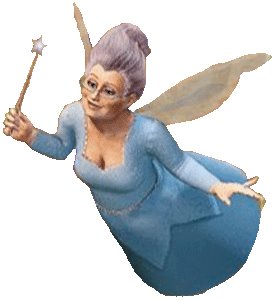
Fairy godmother is the most powerful women in the “Shrek 2” as she has the magic wand that has connotations a phallic object. The phallic object represents “power” and is used to stop the male audience feeling castrated. Moreover, it conveys how patriarchy still exists as to have “power” you need to have a penis/ be un-castrated. Although, the fairy godmother has “power” she is still not a likeable character and therefore seen as a villain which reinforces misogyny.
In the scene where Shrek and his friends are trying to get into the castle. Shrek is shown riding on a white horse which reinforces the stereotypes of a typical hero at this point the audience are position to identify with him as the hero. Therefore the audience experience narcissism as they wish to be like him ideally another scene where the audience experience this is when shrek wakes up and finds out he is a human, the point of view shot helps create a sense of identification with him. furthermore in this scene, three women are all over Shrek, which again reinforce patriarchy.
Classic realism is applied as “Shrek 2” follows a Todorovian narrative structure. It have Starts of with an equilibrium – Shrek and Fiona on their honeymoon, then the dis-equilibrium begins when they receive and invitation from Fiona's parents. Finally, the resolution when Shrek and Fiona are accepted my the people in “far far away”.

Fairy godmother is the most powerful women in the “Shrek 2” as she has the magic wand that has connotations a phallic object. The phallic object represents “power” and is used to stop the male audience feeling castrated. Moreover, it conveys how patriarchy still exists as to have “power” you need to have a penis/ be un-castrated. Although, the fairy godmother has “power” she is still not a likeable character and therefore seen as a villain which reinforces misogyny.
In the scene where Shrek and his friends are trying to get into the castle. Shrek is shown riding on a white horse which reinforces the stereotypes of a typical hero at this point the audience are position to identify with him as the hero. Therefore the audience experience narcissism as they wish to be like him ideally another scene where the audience experience this is when shrek wakes up and finds out he is a human, the point of view shot helps create a sense of identification with him. furthermore in this scene, three women are all over Shrek, which again reinforce patriarchy.
Classic realism is applied as “Shrek 2” follows a Todorovian narrative structure. It have Starts of with an equilibrium – Shrek and Fiona on their honeymoon, then the dis-equilibrium begins when they receive and invitation from Fiona's parents. Finally, the resolution when Shrek and Fiona are accepted my the people in “far far away”.
Wednesday, November 15, 2006
Summary of Laura Mulvey’s theory
Laura Mulvey (a feminist film theorist) came up with the theory of the “male-gaze”. The paper she wrote based on it was called “visual pleasure and narrative cinema” (1975)
Muvey believed that the spectator (audience) were positioned to see things from a male point of view “male gaze” therefore women were objectified (taking away their human qualities and turning them into an object so that their purely there to be looked at) as a result of this patriarchy would be reinforced. This could be because seeing women represented in that way would give the spectator pleasure( these pleasures may be erotic, voyeuristic, sadistic or scopophilic) but at the same time anxiety would be produced if an phallic object or fetish object (such as leather, whips, boots, stockings..) were not exposed because according to Freud by looking at a women in that way would make the man feel castrated which is a man biggest fear as that would be taking away his power. Furthermore, as men liked to have power could suggest why misogyny was introduced which could be for the reason that when men were younger they were controlled by their mothers and the factor that women have the ability to reproduce by giving birth could make them feel very very jealous.
Narcissism is used in cinema when we identify with the hero as that is how we would want ourselves to be ideally.

She made use of Freud’s psychoanalytic theory. Freud was a psychoanalysist, who looked at the human mind and tried to interpret human behaviour, he came up with this theory around the 1900.
He used an iceberg to explain his theory. He stated the top of the ice berg which was about 1/10 was how conscious we were and then bottom of the iceberg which was 9/10 was our unconscious so how much we are not aware. For example he said our dreams was when our unconscious came out and when we have blurted out things which we were not meant to say or don’t know why we said. He used the term resistance for those who refused to accept his theory about the unconscious and repression for those who did not want to know.

Subscribe to:
Posts (Atom)